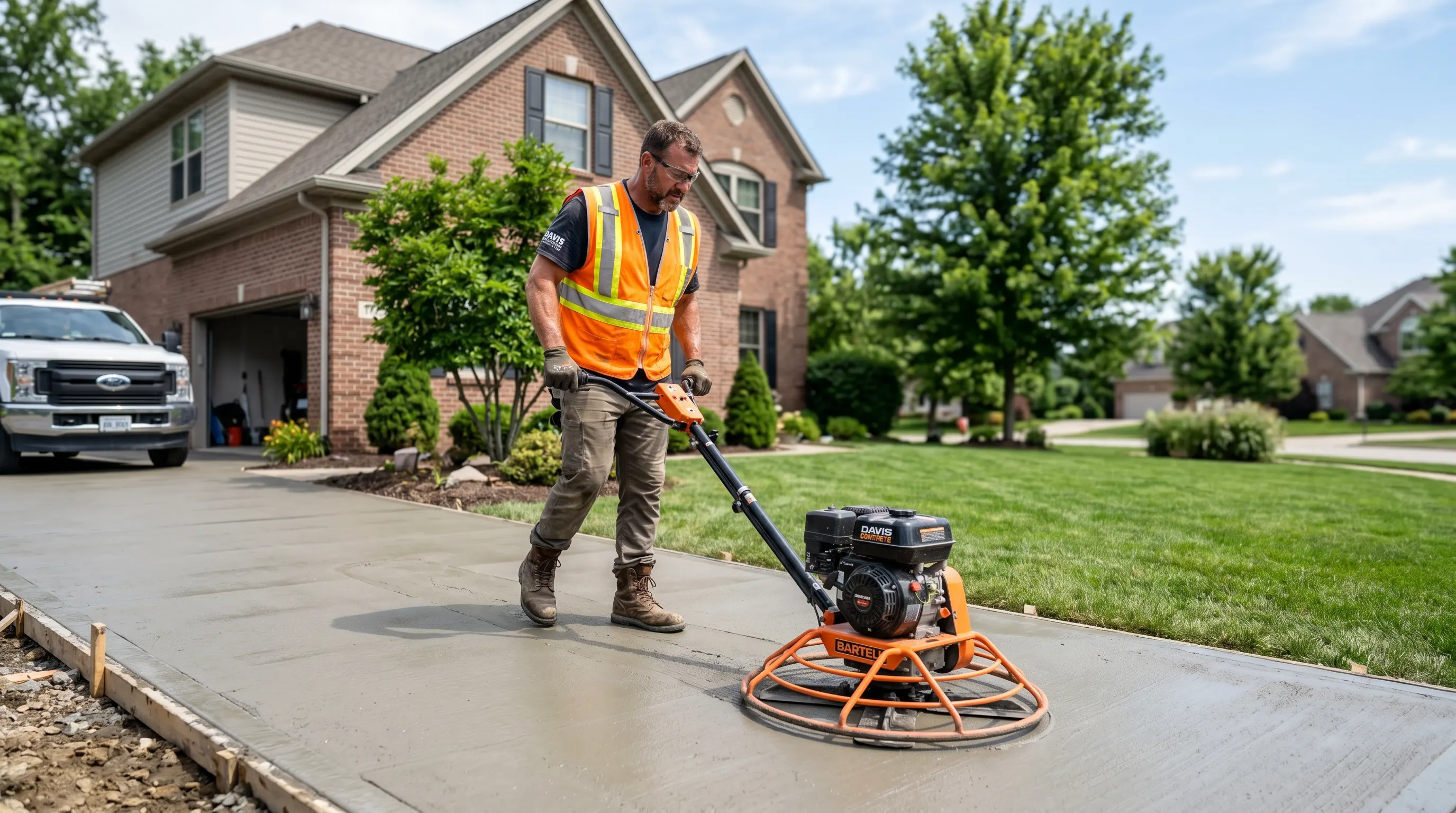
•Charlotte has 14 listed concrete and flatwork professionals with an impressive average rating of 4.8 out of 5 stars, indicating a competitive and quality-driven local market.
•Five companies have achieved a perfect 5.0-star rating, led by Venture Concrete Charlotte (107 reviews) and Neighborly Concrete LLC (98 reviews), offering the strongest combination of rating and review volume.
•Flatwork in Charlotte typically costs $6–$18 per square foot, with full driveway replacements starting at $15,000 or more — costs that can shift based on Charlotte's clay-heavy soil conditions requiring additional base prep.
•Charlotte's humid subtropical climate means summer pours above 90°F require retarding admixtures to prevent premature setting, while the relatively mild winters generally allow year-round work with few cold-weather interruptions compared to northern markets.
•All 14 listed businesses offer direct phone contact, meaning you can get competing estimates quickly — industry standard is a site visit and estimate within one week, with pours typically scheduled 2 to 4 weeks out.
Concrete And Flatwork in Charlotte: What You Need to Know
Charlotte's rapid growth as the Southeast's premier banking center has created relentless demand for residential and commercial concrete work. The city's population of 880,000 — with tens of thousands of new residents arriving each year — has fueled a construction boom that keeps local concrete contractors consistently busy. That demand pressure has practical consequences for homeowners and developers: the best Charlotte concrete contractors are often booked weeks out, and those who wait until spring to schedule a driveway replacement or patio pour frequently find themselves pushed into the summer heat, when high temperatures complicate the pour. Planning ahead and understanding the local market is not optional — it is how you get good work at a fair price.
One of the most underappreciated factors in Charlotte flatwork is the region's red clay soil, which is widespread across Mecklenburg County and the surrounding piedmont. Unlike sandy or loamy soils that drain freely, Charlotte's clay expands and contracts significantly with moisture changes, placing real stress on concrete slabs over time. A competent local contractor will account for this by specifying a proper compacted stone base — typically 4 to 6 inches of crush and run or ABC stone — before any flatwork is poured. Contractors who skip this step to cut costs are setting you up for cracked, heaved, or settled concrete within a few years. This is not a theoretical risk in Charlotte; it is one of the most common causes of premature flatwork failure in this market.
With 14 listed concrete professionals serving the Charlotte metro and a market average of 4.8 stars, consumers here have access to genuinely skilled contractors. The concentration of perfect 5.0-rated companies — including well-reviewed operations like Venture Concrete Charlotte with 107 reviews and Charlotte Concreters with 83 reviews — reflects a mature local trade where word-of-mouth reputation matters. Still, rating alone should not drive your hiring decision. Review count, licensing status, familiarity with local soil and climate conditions, and the quality of their written proposal are all factors that separate a good outcome from an expensive mistake.
Charlotte Local Tip: Mecklenburg County requires a building permit for most concrete flatwork that affects drainage, including driveways connecting to public streets and large patio installations. Before your contractor breaks ground, confirm they have pulled the appropriate permit — unpermitted flatwork can complicate home sales and may require costly removal or remediation. A reputable Charlotte contractor will include permit fees in their quote and handle the filing themselves.
How Much Does Concrete And Flatwork Cost in Charlotte?
Concrete pricing in Charlotte sits within the broad national range of $6–$18 per square foot for flatwork, but several local factors push projects toward the higher end of that spectrum more often than homeowners expect. First, Charlotte's clay soil almost universally requires more base preparation than markets with sandy or gravel-rich soil profiles. That added excavation and gravel work adds cost before a single yard of concrete is poured. Second, the city's hot summers mean contractors often need to use set-retarding admixtures during peak months to give themselves adequate working time, and those chemical additives carry a cost. Third, fuel and material delivery costs in a sprawling metro like Charlotte — which covers more than 300 square miles — vary depending on whether your project is in-town or in the outer suburbs of Mint Hill, Steele Creek, or Huntersville.
For full driveway replacements, budget a minimum of $15,000 for a standard two-car residential driveway once you factor in saw-cutting, demolition, haul-away, base preparation, pour, finishing, and curing. Decorative flatwork — stamped concrete patios, exposed aggregate driveways, or colored broom-finish walkways — commands premium pricing in the $14–$18 per square foot range because the labor intensity is significantly higher. Plain broom-finish flatwork for a sidewalk or utility pad sits at the lower end of the range. Always get itemized quotes so you can see exactly what is included in base prep, reinforcement (rebar or wire mesh), thickness specifications, and finishing.
Service
Low Estimate
High Estimate
Notes
Standard Flatwork (sidewalks, utility pads)
Low$6
High$9
Per sq ft. Plain broom finish, 4-inch slab. Base prep varies by soil conditions — Charlotte clay may add $1–$2/sq ft.
Residential Driveway (new or replacement)
Low$10
High$15
Per sq ft. Includes demolition, 4–6-inch ABC stone base, 4-inch reinforced concrete. Full replacement typically $15,000+ for two-car width.
Patio or Pool Deck (standard finish)
Low$8
High$13
Per sq ft. Broom or salt finish. Drainage planning critical given Charlotte's heavy summer storm events.
Decorative / Stamped Concrete
Low$14
High$18
Per sq ft. Includes stamping, integral or broadcast color, sealer. Popular for Charlotte front entries and outdoor living spaces.
Money-Saving Tip for Charlotte Homeowners: Schedule your concrete project for late September through November. Charlotte's fall weather — consistently in the ideal 50–85°F pour temperature range — means contractors can work efficiently without cold-weather or hot-weather admixtures, reducing material costs. Fall also tends to be a slower booking period after the summer construction rush, which gives you more negotiating leverage and better contractor availability. Getting three competing quotes from the 14 listed Charlotte professionals takes less than a week and routinely reveals price spreads of 20–30% for identical scopes of work.
How to Choose the Right Concrete And Flatwork Contractor in Charlotte
5 Questions to Ask Before Hiring a Charlotte Concrete Contractor
Are you a state-licensed concrete contractor in North Carolina, and can you provide your license number? The right answer is yes, with immediate access to their license number. North Carolina requires contractors performing work above certain thresholds to hold a state license. Any hesitation or deflection on this question is disqualifying. You can cross-reference the number with the NC Licensing Board for General Contractors.
What base preparation are you including, and how are you accounting for Charlotte's clay soil? The right answer describes a minimum 4-inch compacted ABC stone or crush-and-run base, with potential for deeper excavation if soil conditions warrant. A contractor who glosses over base prep or describes it vaguely is cutting corners that will show up as cracking or settlement within a few years.
How will you handle curing, and what is your process for hot-weather pours above 90°F? The right answer includes a specific curing method — wet burlap, curing blankets, or a chemical curing compound — and mentions the use of set-retarding admixtures during Charlotte's summer heat. Concrete poured in high heat without retarders can set too quickly to finish properly, leading to surface defects and weakened structure.
Will you pull the required permits for this project, and is that included in your quote? The right answer is yes, permits are pulled by the contractor and included in the quoted price. Contractors who suggest you pull your own permit or imply permits are unnecessary for substantial flatwork are either uninformed about local code or trying to avoid accountability.
Can you provide a written, itemized contract specifying concrete mix design (PSI rating), slab thickness, reinforcement type, and payment schedule? The right answer is an unequivocal yes. For Charlotte residential flatwork, specify a minimum 3,500 PSI mix for driveways and 3,000 PSI for patios and walkways. Any contractor unwilling to put these specifications in writing should not be hired.
Red Flags When Hiring Concrete And Flatwork Contractors in Charlotte
Red Flags to Watch For When Hiring a Charlotte Concrete Contractor:
Demands large cash upfront payments — A legitimate contractor typically asks for 10–30% at contract signing, with the balance due at project milestones or completion. Anyone demanding 50% or more upfront in cash before mobilizing is a serious risk, particularly in a busy market like Charlotte where fly-by-night operators follow construction booms.
Cannot provide a physical business address or proof of insurance — Charlotte's legitimate concrete contractors carry general liability insurance and, if they have employees, workers' compensation coverage. An uninsured contractor working on your property exposes you to liability if a worker is injured on your job site. Ask for certificates of insurance naming you as the additional insured.
Vague or verbal-only proposals — If a contractor will not provide a written scope of work with specified slab thickness, concrete PSI, base preparation details, and finishing specifications, you have no recourse when the finished product does not meet your expectations. In Charlotte's active construction market, verbal agreements routinely lead to disputes.
Pricing dramatically below all other quotes — A quote that is 40–50% below the next lowest bid almost always means something critical is being omitted — base preparation, proper reinforcement, adequate concrete thickness, or licensed labor. In Charlotte's clay soil environment, shortcuts in base prep and mix design are not recoverable; they result in failed flatwork that must be completely replaced.
No references or reviewable project history in the Charlotte area — New-to-market contractors without local references may lack familiarity with Charlotte's specific soil conditions, local permitting requirements, and the climate-driven pour timing challenges that experienced local operators know instinctively. Ask for references from projects completed within Mecklenburg County specifically.
Top-Rated Concrete And Flatwork Contractors in Charlotte
Among the 14 listed concrete and flatwork professionals serving Charlotte, five companies have earned a perfect 5.0-star rating. What distinguishes the strongest performers is not just their rating — it is the combination of rating and the volume of reviews behind it, which reflects consistent performance across many projects rather than a handful of satisfied early customers.
Venture Concrete Charlotte stands out as the most review-validated perfect-rated contractor in the Charlotte market, with 107 reviews backing their 5.0-star rating. That volume of feedback across a diverse range of Charlotte projects — driveways, patios, commercial flatwork — represents a consistent track record that is difficult to fake or sustain without genuine quality control. Neighborly Concrete LLC and Charlotte Concreters follow closely with 98 and 83 reviews respectively, both at 5.0 stars, making them among the most dependable choices for Charlotte homeowners seeking both quality and accountability. Concremex - Concrete Contractor rounds out the high-volume perfect-rated group with 45 reviews at 5.0 stars, a strong showing that suggests specialized expertise and reliable execution.
Atlantic Concrete Services holds the distinction of being the top-rated company in the directory with a 5.0-star rating, though with 6 reviews it represents a smaller review base than some of its peers. This does not diminish the quality indicated — early review patterns often reflect boutique operators doing meticulous work on a select number of projects — but prospective clients should weigh it accordingly and ask for a robust reference list to supplement the online record. Across all five top-rated companies, the consistent theme in Charlotte's concrete market is that the best contractors are transparent about their process, responsive to client communication, and knowledgeable about local conditions.
Company
Rating
Reviews
Best For
Venture Concrete Charlotte
5.0★
107
Homeowners and developers wanting the highest-volume proof of consistent quality; strong choice for complex driveways and large patio projects across the Charlotte metro
Neighborly Concrete LLC
5.0★
98
Residential clients seeking a contractor with deep community roots and a broad portfolio of Charlotte-area flatwork; well-suited for driveway replacements and backyard patio installations
Charlotte Concreters
5.0★
83
Projects requiring both volume of work experience and top-tier finishes; a reliable option for homeowners in Charlotte's suburban growth corridors like Ballantyne, Steele Creek, and University area
Concremex - Concrete Contractor
5.0★
45
Clients looking for specialty or decorative flatwork with a contractor that has built a strong reputation for precision finishing and professional communication in the Charlotte market
Atlantic Concrete Services
5.0★
6
Clients who prefer a boutique, highly attentive contractor for select projects; ideal for those who prioritize direct owner involvement and are willing to vet through personal references given the smaller review base
Seasonal Guide for Concrete Work in Charlotte, NC
Charlotte's humid subtropical climate is one of the most workable environments for concrete in the entire mid-Atlantic and Southeast region — but it is not without its seasonal hazards. Understanding the Charlotte weather calendar and how it maps to concrete performance is essential for anyone planning a significant flatwork project.
Spring (March through May) is the most popular booking window in Charlotte, and for good reason. Daytime temperatures settle into the ideal 50–85°F pour range, humidity is moderate, and rain events — while present — are typically not the convective downpour events that define summer afternoons. The downside is that every other homeowner in Charlotte has the same instinct. Spring slots with the top-rated contractors fill up in February and sometimes January. If you want a spring project, begin getting quotes and locking in a contractor by late January at the latest.
Summer (June through August) is Charlotte's most challenging season for concrete. Afternoon temperatures routinely exceed 90°F, and high humidity compounds the problem by affecting how concrete cures at the surface. Heat accelerates the hydration reaction, meaning concrete can begin to set before finishers have completed their work — leading to surface cracking, finishing defects, and compromised long-term durability. Experienced Charlotte contractors manage this with set-retarding admixtures added at the batch plant, by scheduling pours for early morning when temperatures are lowest, and by using evaporation retarder products on the slab surface during finishing. If your contractor cannot articulate a specific hot-weather protocol, do not hire them for a summer pour. Charlotte also experiences severe afternoon thunderstorms in summer — a legitimate concern because rain on fresh concrete can damage the surface finish and dilute the water-cement ratio, weakening the slab. Good contractors monitor radar and have protocols for protecting fresh pours.
Fall (September through November) is the expert's choice for Charlotte concrete work. Temperatures drop into the ideal range, storm frequency decreases significantly after mid-September, contractor schedules open up after the summer rush, and there is no cold-weather risk until late November at the earliest. Homeowners who plan a fall project consistently report smoother project execution, better contractor availability, and in many cases lower pricing due to reduced demand pressure. This is the window to target if your project timeline is flexible.
Winter (December through February) in Charlotte is manageable but requires attention. Unlike markets in the NC mountains or the Northeast where winter concrete work from November through March carries serious freeze-thaw risk, Charlotte rarely sustains temperatures below 32°F for extended periods. That said, when cold fronts push nighttime temperatures into the 20s, freshly poured concrete must be protected with insulating blankets and potentially heated enclosures. Below 40°F, cold-weather admixtures — accelerators like calcium chloride — are needed to ensure adequate strength gain before the concrete is exposed to freeze-thaw cycling. Most Charlotte contractors will continue working through mild winter stretches but will reschedule pours when hard freezes are forecast. Verify your contractor's winter pour policy before signing a contract for a December or January project.
Frequently Asked Questions About Concrete And Flatwork in Charlotte
How long does a concrete driveway last in Charlotte, NC?
A properly installed concrete driveway in Charlotte should last 30 to 50 years with reasonable maintenance. The key variables in Charlotte specifically are base preparation and slab thickness. Because Mecklenburg County's red clay soil expands and contracts with moisture, driveways installed on inadequate gravel bases often begin cracking within 5 to 10 years. A 4-inch slab on a minimum 4-inch compacted ABC stone base is the standard residential specification; 5-inch slabs are recommended for driveways that see truck or heavy vehicle traffic. Sealing your concrete every 3 to 5 years protects the surface from Charlotte's UV exposure and prevents water infiltration at control joints, which is the primary pathway to long-term freeze-thaw and clay-heave damage. Avoid using rock salt or chloride-based deicers in the rare event of Charlotte ice events, as these accelerate surface scaling.
Do I need a permit for a concrete driveway or patio in Charlotte?
Yes, in most cases. Mecklenburg County and the City of Charlotte require permits for new driveways, driveway replacements that change the footprint or grade, and larger flatwork installations that affect stormwater drainage. Specifically, any driveway apron connecting to a public street typically requires a Right-of-Way permit from the Charlotte Department of Transportation in addition to any applicable building permit. The permitting requirement exists partly because Charlotte has significant stormwater management mandates — adding impervious surface in certain drainage basins requires review and sometimes mitigation. A reputable, state-licensed Charlotte contractor will identify which permits apply to your project and pull them as part of their service. Do not accept assurances that permits are 'not needed' for significant flatwork without verifying that claim independently with Mecklenburg County Code Enforcement.
Find Concrete Contractors Professionals in Charlotte
Browse top-rated contractors, compare reviews, and get free quotes.
What is the best concrete mix specification for a Charlotte driveway?
For a residential driveway in Charlotte, specify a minimum 3,500 PSI (pounds per square inch) compressive strength mix with a water-cement ratio no higher than 0.50. Charlotte's summer heat makes slump management critical — your contractor should order a mix with a slump of 4 to 5 inches maximum and should never add water at the job site to make the mix easier to work with, as this weakens the concrete and increases shrinkage cracking. For driveways, specify 6x6 W2.9xW2.9 welded wire reinforcement or #3 rebar at 18 inches on center — both are acceptable, but rebar provides superior crack control in Charlotte's clay soil movement environment. Air entrainment (4–6% air) is standard practice even in Charlotte's mild climate because it significantly improves durability and resistance to surface scaling.
How long does concrete take to cure in Charlotte's climate, and when can I drive on my new driveway?
Concrete reaches approximately 70% of its design strength within 7 days under normal Charlotte conditions and approaches full design strength at 28 days. As a practical matter, you can walk on a new concrete driveway after 24–48 hours and drive passenger vehicles on it after 7 days. Avoid heavy trucks, loaded trailers, or construction equipment for a full 28 days. In Charlotte's summer heat, the early hydration process moves faster but can produce higher internal temperatures that, paradoxically, require more careful curing management — not less. Your contractor should apply a chemical curing compound or keep the slab moist for a minimum of 7 days post-pour. Skipping or shortcutting the curing period is one of the most common causes of surface dusting, scaling, and early cracking in Charlotte flatwork.
How do I get accurate quotes from Charlotte concrete contractors, and what should be included?
To get accurate, comparable quotes from Charlotte's 14 listed concrete professionals, you need to provide each contractor with the same written scope of work so you are comparing apples to apples. Your scope should specify the exact dimensions and location of the work, whether demolition of existing concrete is required, your desired finish type (broom, exposed aggregate, stamped, etc.), and any grade or drainage requirements. A complete quote from a Charlotte contractor should itemize: demolition and haul-away costs if applicable, excavation depth and base material specification, concrete mix design (PSI and thickness), reinforcement type, finishing specification, control joint layout, curing method, permit fees, and cleanup. Industry standard for Charlotte is a site visit and written estimate within one week of your request, with the project scheduled 2 to 4 weeks from contract signing depending on the contractor's workload. Getting three quotes from rated Charlotte contractors — particularly among the five with 5.0-star ratings — is a reliable way to establish a fair market price for your specific project.